

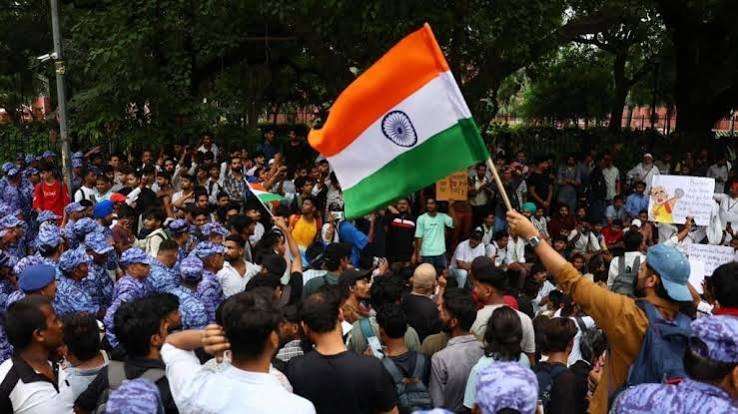
Thousands of youth activists and students gathered at Jantar Mantar and began marching toward Parliament House and the Reserve Bank of India. The surge in demonstrations coincided with the first day of the Parliament’s Monsoon Session.
Security Crackdown and Clashes
- Baton Charges and Tear Gas: Riot police and central paramilitary forces (including the Rapid Action Force) deployed multi-layered barricading. Clashes erupted near the Reserve Bank of India and the Constitution Club, prompting security forces to use tear gas and baton charges (lathi-charge) to push back crowds.
- Mass Detentions: Several high-profile individuals and hundreds of protesters were detained across central Delhi, including CJP founder Abhijeet Dipke and opposition Lok Sabha MP Dimple Yadav. At least seven people were detained directly outside the Reserve Bank of India. [1, 2]
- Transit & Digital Blackouts: The Delhi Metro Rail Corporation (DMRC) temporarily shut down five key metro stations—including Rajiv Chowk and Central Secretariat—leaving commuters stranded. Authorities also suspended mobile internet services in parts of central New Delhi. [, 2, 3]
Core Demands of the Protesters
The mass mobilization centers around two major grievances:
- The NEET-UG 2026 Paper Leak: Protesters are demanding sweeping examination reforms and the immediate resignation of Union Education Minister Dharmendra Pradhan following nationwide leaks and irregularities.
- Support for Sonam Wangchuk: Climate activist Sonam Wangchuk was forcibly removed by Delhi Police over the weekend after a grueling 20-day hunger strike at Jantar Mantar. From his “illegal detention” at Safdarjung Hospital, Wangchuk released a letter demanding a temporary discharge to join the march.
Current Situation
Following the intense afternoon clashes, the central government reached out to the demonstrators. CJP founder Abhijeet Dipke ended his hunger strike after the government officially opened a line of dialogue, sending a delegation of CJP spokespersons to meet with Union Health Minister J.P. Nadda to discuss their education reform demands.
Meanwhile, opposition parties successfully forced repeated adjournments in both the Lok Sabha and Rajya Sabha over the heavy-handed police action and the exam scandals.
About The Author