



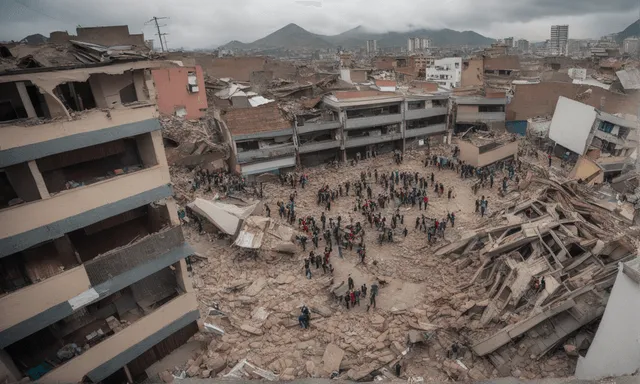
A powerful magnitude 6.7 earthquake struck Peru’s southern Andes on Thursday, shaking several regions and damaging homes, health centers, and a school. At least two people were injured while evacuating their homes, while authorities continued assessing the impact across the affected areas.
The earthquake struck at approximately 1 p.m. local time, according to the United States Geological Survey. Its epicenter was located about 38 kilometers northwest of Upahuacho in Parinacochas province, within the Ayacucho region. The quake occurred at a depth of approximately 66 kilometers.
Strong Tremors Across Southern Peru
The earthquake was felt across a wide area of southern Peru. Residents in Ica, Arequipa, Huancavelica, Apurímac, and Cusco reported experiencing the shaking. Tremors were also felt in Lima, the country’s capital, despite the epicenter being far away in the Andes.
People in several communities reportedly moved out of their homes as the ground shook. In Coracora, the capital of Parinacochas province, two people were injured during the evacuation, according to Luis Vásquez, the head of Peru’s Civil Defense.
The earthquake caused concern among residents because of the mountainous terrain and the vulnerability of some buildings in rural communities. Officials warned that damage assessments could change as emergency teams reached more isolated locations.
Homes And Public Buildings Damaged
Authorities reported damage to 22 homes, six health centers, and one school across districts in Ayacucho and Cusco. The affected areas included Puquio, Pullo, Coracora, Upahuacho, San Pedro, and Pichari.
The damage highlights the challenges faced by communities in Peru’s highland regions. Many towns are separated by steep roads and remote mountain routes, making it difficult for emergency workers to inspect buildings and deliver assistance immediately after a major tremor.
Rockfalls were also reported on hillsides near Coracora. Such incidents can block roads, damage vehicles, and make it harder for residents to leave affected areas. Authorities were expected to continue monitoring roads and slopes for additional hazards.
No Tsunami Threat Reported
Despite the strength of the earthquake, the Peruvian Navy ruled out a tsunami threat. This provided some relief to coastal communities and residents who feared that the earthquake could trigger dangerous waves.
Earthquakes in Peru often create public concern because the country lies along the Pacific Ring of Fire, one of the world’s most active seismic zones. Peru experiences frequent earthquakes because of the movement of tectonic plates beneath the region.
Peru’s History Of Earthquakes
Peru has faced several devastating earthquakes throughout its history. A magnitude 5.5 earthquake in the central highlands in July 2026 killed at least six people, injured more than 20 others, and displaced around 300 residents. The quake damaged or destroyed dozens of homes near Sicaya and Chongos Bajos in the Junín region.
The country also suffered one of its most destructive modern disasters in 1970, when a major earthquake caused widespread destruction and killed approximately 80,000 people. More than 300,000 people were injured in that disaster.
Another major earthquake struck near Peru’s southern coast in 2007. The magnitude 8.0 quake caused deaths, injuries, and extensive damage, particularly around the Ica region.
These events have encouraged Peru to strengthen emergency planning, public education, and earthquake-response systems. However, remote communities still face difficulties because of limited infrastructure and challenging geography.
Emergency Response Underway
Civil Defense officials and local authorities are assessing the damage and supporting residents in the affected districts. Emergency teams are expected to inspect homes, schools, health facilities, bridges, and roads to determine whether they remain safe.
Residents have been advised to remain alert for aftershocks and avoid damaged buildings. Authorities generally recommend moving to open spaces after a strong earthquake, staying away from unstable walls, and following official instructions.
Families in mountainous areas may also need to prepare for temporary road closures caused by rockfalls. Emergency supplies such as drinking water, medicines, flashlights, batteries, and basic food can be especially important when communities become temporarily isolated.
Safety Remains A Priority
The latest earthquake has once again underlined Peru’s exposure to seismic activity. Although the reported number of injuries remained low, the damage to homes and public facilities showed how quickly a strong earthquake can disrupt daily life.
Officials will continue checking affected areas as information becomes available. For residents, the immediate priorities are staying away from damaged structures, watching for aftershocks, and relying on verified updates from Peru’s emergency agencies.
The magnitude 6.7 earthquake in the southern Andes is a reminder that earthquake preparedness remains essential for communities across Peru. While there was no tsunami threat, the reported injuries, building damage, and rockfalls demonstrate the importance of rapid emergency response and stronger disaster planning.
About The Author