



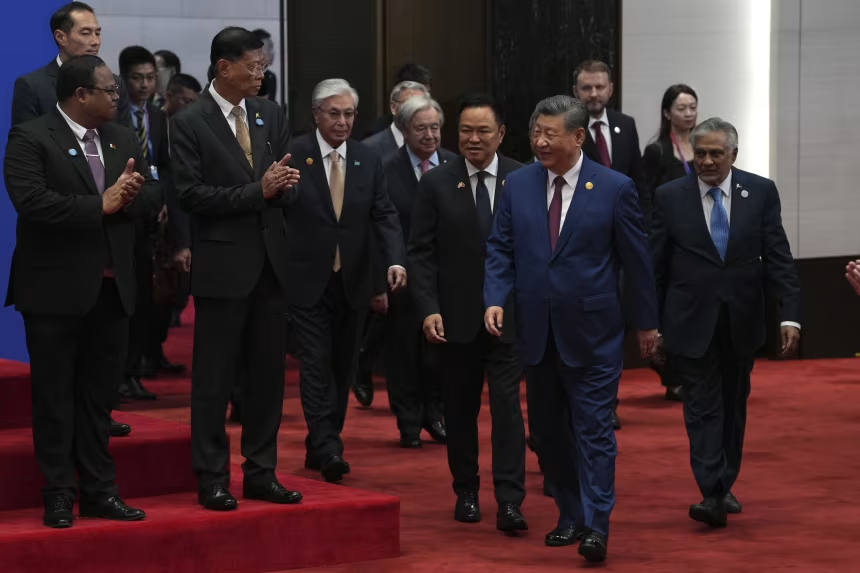
In a striking contrast of narratives, President Donald Trump has leveled explosive accusations that China stole voter data from 220 million Americans—calling it “the largest compromise of election data in history”—even as Chinese President Xi Jinping positions Beijing as a responsible, rule‑following leader in global technology and AI governance.
The clash isn’t just about data. It’s about trust, power, and who gets to define the rules of the digital age.
As Trump Accuses China of Stealing Voter Data, Xi Pitches Beijing as a Responsible Tech Leader
In a primetime address from the White House on July 16, 2026, Trump made a sweeping allegation:
“The People’s Republic of China carried out what is believed to be the largest compromise of election data in history, resulting in China’s illicit acquisition of 220 million US voter files.”
He said the stolen information included:
- Names
- Addresses
- Phone numbers
- Political party preferences
- Other “sensitive” data tied to voter registration
Trump went further, accusing elements of the U.S. intelligence community—the so‑called “Deep State”—of suppressing and downplaying what he called China’s “sinister election meddling.” He claimed U.S. spy agencies first learned about the breach in 2020 but kept it hidden from both the president and the public.
As part of the speech, the White House said it was declassifying documents related to the alleged breach, though many outlets reported the released material was heavily redacted and did not show evidence that any votes were actually changed.
What Experts and Officials Are Saying
Trump’s claims have been met with strong pushback:
- U.S. intelligence assessments: A 2021 intelligence report concluded with “high confidence” that China did not attempt to influence the outcome of the 2020 election.
- Senator Mark Warner (Senate Intelligence Committee) called the allegations “totally bogus,” noting that intelligence agencies unanimously found China never tried to change a single vote.
- Former NSC official Miles Taylor disputed Trump’s claim that the information was hidden, saying the administration had been briefed on China’s data activities.
Election law experts also point out a key detail:
- In many U.S. states, voter registration data is public or commercially available.
- Twenty states and Washington, D.C., will provide voter data with a simple public request, purchase, or online download.
- Having names, addresses, and party preferences does not by itself allow someone to alter voter rolls or cast ballots, because most states require additional identifiers like driver’s license or Social Security information.
In short: while the scope of data access sounds alarming, there is no public evidence that China changed votes or tampered with election results.
Xi’s Counter‑Narrative: China as a “Responsible” Tech Leader
While Trump frames China as a digital threat, Xi Jinping and Beijing are pushing a different story on the global stage:
- AI governance: China has positioned itself as a proponent of international AI rules, backing UN‑led frameworks and calling for “inclusive” and “equitable” governance that gives developing nations a voice.
- Responsible innovation: Official statements emphasize “ethical AI,” data security laws, and cooperation on standards, portraying China as a mature, rule‑based tech power.
- Global South leadership: By championing technology access and infrastructure investment in Asia, Africa, and Latin America, Beijing seeks to contrast itself with what it calls Western “tech hegemony.”
The message from Beijing is clear: We are not the problem; we are part of the solution.
The Bigger Picture: A Battle Over Trust in Technology
This tug‑of‑war is about more than one speech or one data set. It’s about:
- Who sets the rules: Will AI, data flows, and digital infrastructure be shaped by Washington, Beijing, Brussels—or a mix?
- Narrative power: Trump’s accusations reinforce a view of China as a cyber‑aggressor. Xi’s messaging tries to reframe China as a responsible steward of technology.
- Global impact: Countries in the Global South, in particular, are watching closely—deciding which model to follow for 5G, surveillance tech, AI platforms, and data laws.
For everyday users, the stakes are real:
- How secure is your data?
- Who can access it, and under what rules?
- Can you trust elections, platforms, and devices in an era of constant cyber claims?
Why This Matters for You
Whether you’re a business owner, a voter, or just someone scrolling through news:
- Election security doubts can erode faith in democracy itself—even when no votes are proven to have changed.
- Tech leadership narratives influence which apps, devices, and platforms gain global trust—and which get banned or restricted.
- Data protection debates shape laws that affect everything from social media to banking to healthcare.
In this environment, claims like Trump’s and counter‑messages from Xi aren’t just politics. They’re part of a long‑term struggle over who controls the digital future.
Final Thought: Two Stories, One Digital World
On one side: a U.S. president warning that China stole a massive trove of American voter data and calling it an existential threat to election integrity.
On the other: a Chinese president pitching Beijing as a responsible, cooperative leader in AI and technology, ready to help write the world’s digital rules.
Both narratives can’t be fully true. But both are shaping how governments, companies, and citizens think about risk, trust, and power in the 21st century.
As the U.S. midterms approach and global tech talks continue, expect this clash of stories—and of systems—to only intensify.
About The Author


