



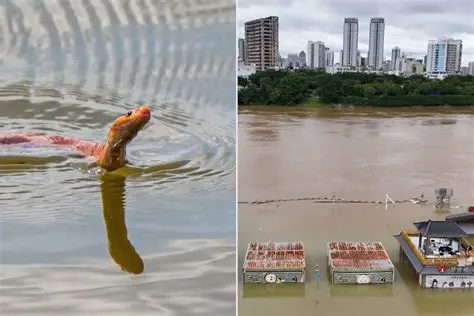
Natural calamities often devastate landscapes, but occasionally they unleash horrors that feel almost mythological. In July 2026, southern China’s Guangxi province endured torrential rains that transformed tranquil villages into watery labyrinths. Homes were submerged, roads dissolved into rivers, and families were uprooted. Yet the most chilling twist was not the flood itself—it was the escape of hundreds of serpents, including venomous cobras, into the inundated streets, turning survival into a surreal nightmare.
Chaos in Hangzhou
Hangzhou bore the brunt of this uncanny disaster. Snake farms, overwhelmed by the relentless surge, became accidental gateways of terror. Nearly 900 snakes slithered free, dispersing into waist‑deep waters and infiltrating homes. For residents already grappling with the flood’s ferocity, the sudden apparition of cobras and rat snakes added a sinister dimension.
Picture the scene: villagers wading through turbid waters, clutching bamboo poles, their eyes darting at every ripple. A cobra’s hood unfurling in the gloom was no longer a spectacle of nature—it was a mortal threat. Rescue brigades mobilized with extraordinary urgency, deploying 8,000 personnel and 5,700 boats to wrestle with both the floodwaters and the serpentine menace.
The familiar streets of Hangzhou metamorphosed into hostile waterways, where every shadow concealed uncertainty and every splash could herald venom.
Human Toll
The peril was tragically palpable. One woman succumbed to a snakebite, her fate sealed by the cruel delay of medical aid—roads fractured by the flood made hospitals unreachable. Her death became emblematic of the disaster’s merciless unpredictability, a reminder that catastrophe often strikes at the intersection of vulnerability and chance.
Authorities scrambled to erect emergency clinics in beleaguered villages, offering immediate treatment for bite victims. Physicians and nurses labored ceaselessly, tending to snakebite wounds alongside flood‑related injuries. Yet the psychological burden was as heavy as the physical one. Families displaced by the waters now lived under the constant dread of venomous intruders. Parents forbade children from venturing outside, rescue workers advanced with wary steps, and communities endured sleepless nights haunted by the hiss of unseen predators.
Survivors recounted harrowing encounters: children narrowly spared from bites, serpents discovered coiled inside boats, and reptiles slithering across the thresholds of flooded homes. Each episode reinforced the sense that the flood was not merely a battle against rising waters but against venom itself.
The woman’s tragic demise was echoed in countless near‑misses. Her story became a chilling refrain, whispered in shelters and repeated in hushed tones, a reminder that survival hinged on vigilance and fortune.
A Double Burden
Floods typically signify ruined harvests, collapsed dwellings, and displaced families. But in Guangxi, the calamity carried a double burden: the duel against water and the duel against venom. Survivors spoke of eerie silences punctuated by sudden splashes, of serpentine heads breaking the surface like apparitions.
Children were confined to makeshift shelters, elders warned against bare feet, and rescue workers navigated with heightened caution. The flood transformed daily existence into a precarious balancing act—every step a gamble, every movement shadowed by dread.
The psychological toll was immense. Fear seeped faster than the floodwaters, saturating households with anxiety. Even those who never glimpsed a snake lived with the gnawing suspicion that danger lurked nearby. The calamity became not only a physical ordeal but an emotional crucible, testing the endurance of entire communities.
Parents struggled to soothe children who wept at night, terrified by tales of serpents gliding through the waters. Elderly residents spoke of helplessness, trapped indoors by the menace outside. Rescue workers admitted their mission was complicated not only by the flood’s ferocity but by the vigilance required to avoid venomous strikes.
The flood was relentless, a test of patience and fortitude. Each hour brought fresh challenges, each day carried the weight of uncertainty. For Guangxi’s residents, survival meant coexisting with fear as an uninvited companion.
Conclusion
As rescue operations persist, the saga of Guangxi’s snake flood endures as a chilling parable of nature’s caprice. It illustrates how disasters can compound suffering, transforming a flood into a duel with venom and dread.
The woman who perished, the families who endured sleepless nights, and the rescue workers who braved both water and serpents embody the human toll of this catastrophe. Their experiences remind us that disasters are not sterile statistics—they are lived realities of anguish, courage, and endurance.
The Guangxi snake escape will be remembered not merely as a bizarre twist of fate but as a haunting chronicle of survival. It is a reminder that when floods rise, they carry more than water—they carry the unpredictable, often terrifying force of nature itself.
About The Author


